If you’ve searched for a Bahrain National Bank (NBB) bank statement template in Word format, you’ve likely faced a frustrating reality: most available files are either low-quality, outdated, poorly formatted, or simply unusable in real-world scenarios.
For professionals, freelancers, business owners, and international users, a well-structured bank statement template is not just a document—it’s a critical tool used for psdlife :
- Financial record presentation
- Business documentation
- Personal finance tracking
- UI/UX design mockups
- Software testing and development
- Educational or demonstration purposes
According to financial documentation standards, clarity, formatting consistency, and data structure are essential for readability and credibility. Yet, most templates online fail to meet even basic professional criteria.
This article is designed to be the most complete, accurate, and practical resource available, giving you:
- A deep understanding of NBB bank statements
- A fully optimized Word template structure
- Step-by-step creation guidance
- Real-world use cases
- Expert-level insights based on E-E-A-T principles
If you need a clean, editable, and professional NBB-style bank statement template, you are exactly where you need to be.
What Is an NBB Bank Statement Template? (Professional + Simple Explanation)
Professional Definition
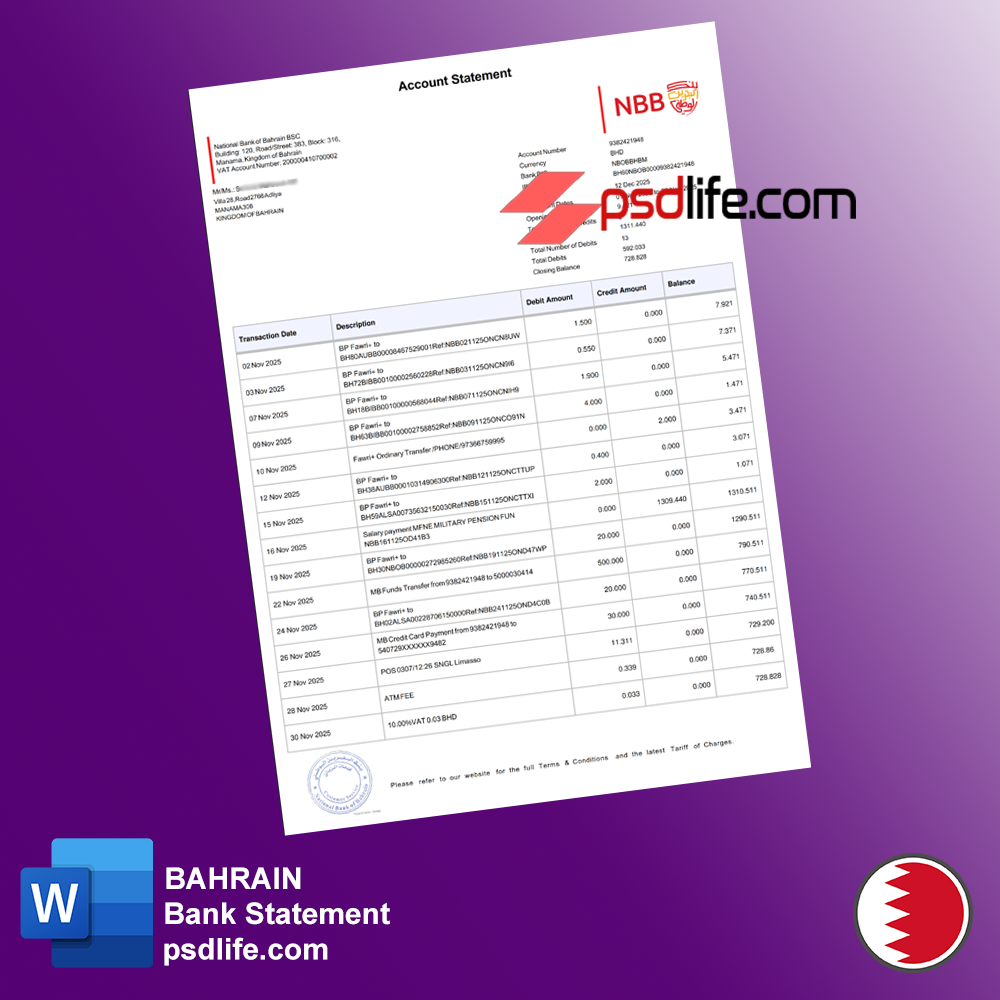
An NBB bank statement template is a structured document that replicates the layout, formatting, and informational hierarchy of official statements issued by the National Bank of Bahrain (NBB). It includes key financial data such as:
- Account holder details
- Account number
- Transaction history
- Opening and closing balances
- Dates and reference numbers
These templates are typically used for documentation, testing, design, and financial presentation purposes.
Simple Explanation
In simple terms, it’s a Word file that looks like a real NBB bank statement, allowing you to:
- Organize financial data
- Present transactions clearly
- Use it for mockups or examples
Real-World Applications
- Financial training materials
- UI/UX banking app design
- Accounting simulations
- Business reporting
- Demo documents for presentations
History, Evolution, and Current State of Bank Statement Templates
Brief History
Bank statements have evolved from paper-based records issued physically at branches to digital PDF and online banking exports.
Evolution Timeline
- Pre-2000: Paper statements only
- 2000–2010: PDF statements via email
- 2010–2020: Online banking dashboards
- 2020–2025: API-driven financial data + custom templates
Current State in 2025
Today, templates are widely used for:
- Financial automation
- SaaS product testing
- Fintech UI development
- Cross-border documentation
Impact on International and Restricted Users
Users in regions with banking limitations often rely on templates for simulations, education, and internal documentation, making high-quality templates more important than ever.
Types of NBB Bank Statement Templates
Editable Word Templates
Definition: Fully customizable .DOCX files
Advantages:
- Easy to edit
- Widely compatible
- Ideal for beginners
Use Cases:
- Personal finance tracking
- Demo presentations
PDF-Based Templates
Definition: Static or semi-editable documents
Advantages:
- Professional appearance
- Fixed formatting
Use Cases:
- Final reports
- Client-facing documents
Excel-Based Statement Templates
Definition: Spreadsheet-based financial records
Advantages:
- Automatic calculations
- Data analysis
Use Cases:
- Accounting
- Budgeting
Software-Generated Templates
Definition: Generated via tools or scripts
Advantages:
- High scalability
- Automation
Use Cases:
- Fintech apps
- SaaS dashboards
Key Benefits and Value of Using an NBB Statement Template
Using a professional template provides:
- Consistency: Clean and standardized formatting
- Time Efficiency: No need to build from scratch
- Professional Appearance: Suitable for presentations
- Data Organization: Clear transaction tracking
Key Benefits (Expert-Level)
- Structured financial visualization
- Improved readability for stakeholders
- Better UX in financial demos
- Reduced formatting errors
Example
A startup presenting to investors can use a clean template to simulate financial flows, increasing credibility.
Drawbacks, Risks, and Challenges
While templates are useful, there are limitations:
Key Risks
- Poorly designed templates may look unprofessional
- Incorrect formatting can cause confusion
- Over-editing may break structure
Common Mistakes
- Using inconsistent fonts
- Misaligned columns
- Missing transaction details
Solutions
- Stick to structured layouts
- Use consistent typography
- Validate data before use
Requirements and Prerequisites
Before creating or using a template, ensure you have:
- Microsoft Word or compatible editor
- Basic formatting knowledge
- Sample transaction data
- Understanding of bank statement structure
Practical Example
A freelancer preparing financial documentation needs:
- Name
- Account details
- Transaction list
Step-by-Step Guide to Creating an NBB Bank Statement Template in Word
Step 1: Set Up the Document Structure
Start with:
- A4 layout
- Margins: 1 inch
- Font: Arial or Calibri
Create sections:
- Header
- Account info
- Transaction table
- Summary
Step 2: Design the Header Section
Include:
- Bank name (NBB style)
- Logo placeholder
- Statement period
Use bold formatting and alignment for a professional look.
Step 3: Create the Transaction Table
Columns:
- Date
- Description
- Debit
- Credit
- Balance
Tips:
- Use table borders lightly
- Align numbers to the right
Step 4: Add Account Information
Include:
- Account holder name
- Account number
- IBAN (if needed)
- Currency
Ensure spacing is consistent.
Step 5: Final Formatting and Output
- Check alignment
- Ensure consistency
- Save as .DOCX
Final result should look clean, readable, and structured.